
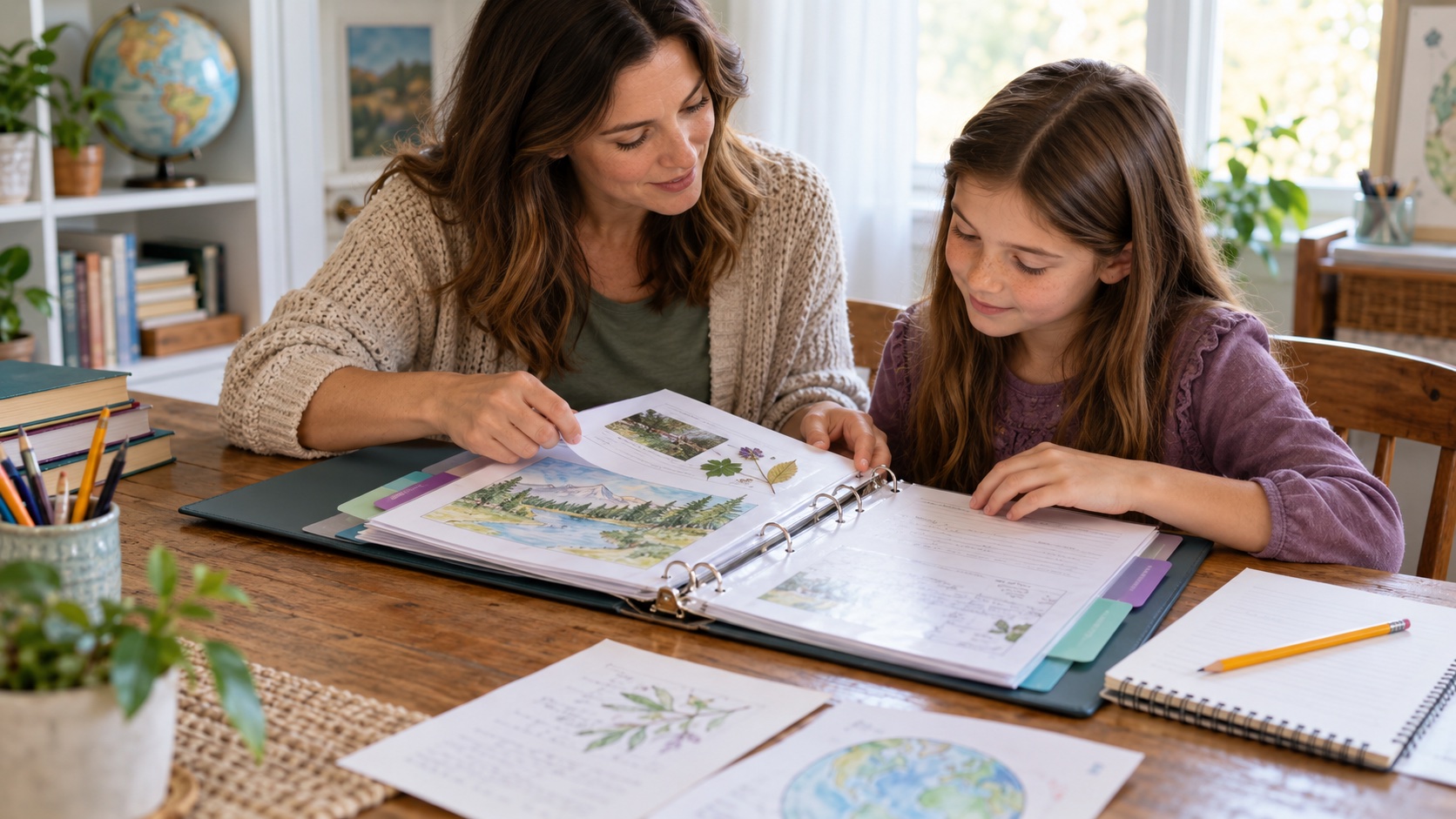
A useful homeschool portfolio does not have to contain every worksheet, assignment, or drawing produced during the year. Its job is to create an organized record of what was studied and, when appropriate, show examples of a student's work and progress.
Some families build a portfolio because their state or homeschool program requires one. Others prepare materials for an evaluator, document learning for a future school transition, or simply keep a meaningful family record. Those purposes are not interchangeable.
Important: The organizational ideas in this guide are suggestions, not a universal list of records every homeschool must keep. Requirements can change, and families should confirm current rules with the appropriate official authority before relying on a deadline, form, retention requirement, or portfolio procedure. This article is general information, not individualized legal advice.
Know what kind of portfolio you are building
“Homeschool portfolio” can describe several different collections. Before choosing folders or scanning work, write down the portfolio's purpose.
- a formal portfolio required under a particular homeschool route
- materials prepared for an evaluator or reviewer
- a family record of the school year
- a collection showing academic progress
- records that may help with later enrollment or course documentation
First determine whether a formal requirement applies. Read Homeschool Requirements by State: Where to Find Rules and Standards, then confirm your route and current instructions with the responsible state or local authority. If no formal portfolio applies, you can design a lighter record that serves your family's own goals.
Keep a clear boundary between records that are useful and records that are legally required where you live.
Start with a simple record of the school year
Give the collection enough context that someone can understand it later. A one-page cover sheet might list:
- student name
- school year
- grade or approximate level, when useful
- subjects or courses studied
- curriculum and major resources used
- relevant dates
These are organizational suggestions unless your state, evaluator, school, or program specifically requires them. Keep this overview short. The portfolio should explain the year, not become another curriculum plan.
Decide what is actually worth saving
A box containing everything may preserve the year, but it rarely explains it. Choose records that show what the student studied, what the student produced, or how understanding changed.
Possible useful records include:
- writing samples
- selected mathematics work
- science work, lab notes, or project records
- history and social studies assignments
- major projects and research
- quizzes, tests, or other assessments
- reading lists
- lesson plans when they add useful context
- photos of hands-on work that cannot be filed
- art or creative work where relevant
- progress notes
- course descriptions for older students
These examples are not universal legal requirements. A formal portfolio may require different or additional documentation.
| Type of record | What it can show |
|---|---|
| Early and later writing samples | Growth in planning, clarity, and revision |
| Selected math work | Skills practiced and reasoning used |
| Major project | Application of learning across several steps |
| Quiz or assessment | Understanding at a point in time |
| Reading list | Books and texts completed or discussed |
Save examples of progress instead of everything
Representative samples are often easier to understand than dozens of nearly identical pages. For a fractions unit, for example, you might choose one early attempt, one page after additional instruction, and one later example showing more independent work.
The same pattern can work for a writing assignment: an initial draft, feedback or revision notes, and the finished piece. Add one quiz, project, or assessment when it helps show understanding.
A portfolio should make the year easier to understand, not harder to search through.
This is general organizational advice. If a law, evaluator, supervising program, or school requests particular records or a particular volume of work, follow those instructions.
From ChalkDraft: ChalkDraft can create lesson plans, worksheets, quizzes, tests, homework assignments, study guides, discussion questions, and learning activities. A family may choose to retain selected generated and completed materials as part of its own records. ChalkDraft creates learning materials; it does not create a legally compliant portfolio or decide what your family is required to keep.
Choose an organization system you can maintain
Organize by subject
Use sections for mathematics, English/language arts, science, social studies or history, and electives. This makes it easy to view progress within a course.
Organize by month or quarter
A chronological system works well when your family plans in units, seasons, or reporting periods and wants to see how the year unfolded.
Use a hybrid system
Create subject folders, then order the work inside each folder by date. This adds a small amount of setup but shows both subject coverage and progression.
| System | Works well when |
|---|---|
| By subject | You want to see progress within each course |
| Chronological | You want a record of how the year unfolded |
| Hybrid | You want subject organization and progression |
No system is universally best. Choose the one you can use consistently and that fits any formal review you need to complete.
Decide whether the portfolio will be physical, digital, or both
Physical
A binder with subject dividers works for selected pages. File folders can hold bulky items or work that will be sorted later.
Digital
A digital homeschool portfolio can include PDFs, scans, photographs, typed assignments, and exported work. Use descriptive filenames such as 2026-10-science-plant-study.pdf rather than a folder full of files named “scan.”
Hybrid
Keep core records and backups digitally while retaining physical artwork, models, notebooks, or other work that does not scan well.
If a legal rule, evaluator, or supervising program is involved, confirm whether a particular format is expected or permitted. Do not assume a digital-only collection satisfies every jurisdiction or route.
Use a folder structure that stays simple
Here is one model you can copy and adjust:
- Student Information
- Curriculum and Course Plans
- Attendance or Calendar
- Mathematics
- English / Language Arts
- Science
- Social Studies
- Electives
- Assessments
- Projects
- Reading List
- End-of-Year Summary
This is an organizational example, not a list of records every state requires. Remove folders that do not help and add any documentation your applicable rules or program instructions call for.
Update the portfolio during the year
A small routine prevents the portfolio from becoming an end-of-year rescue project. Treat the intervals below as suggestions, not requirements.
| When | What to do |
|---|---|
| Weekly | Put possible work samples in the right folder |
| Monthly | Remove duplicates and obvious busywork |
| Quarterly | Select pieces that best show work and progress |
A temporary “consider for portfolio” folder can help. Save generously during the week, then curate when you have enough distance to see which pieces are useful.
Do an end-of-year review
At the end of the year, remove repetition and make sure the remaining collection tells a coherent story. Depending on your purpose, you might retain:
- a course or subject list
- representative work samples
- major projects and a reading list
- assessments or evaluations
- attendance records when applicable
- curriculum or course descriptions
- a short summary of progress
- official documents required by your state or program
There is no universal retention period for every U.S. homeschool family. Verify any applicable state, program, school-transition, transcript, or diploma requirements before discarding formal records.
Two state examples show why families must check their route
These examples were checked against official state guidance in October 2026. They illustrate differences; they do not summarize every option in either state.
Maryland: local supervision uses portfolio reviews
Under Maryland's home-instruction structure, a parent or guardian may choose supervision by the local school system or by certain registered nonpublic or church-related entities. For families using local school-system supervision, the Maryland State Department of Education says portfolio reviews occur twice a year, generally at the end of each semester. The reviewer may ask for materials demonstrating regular, thorough instruction in the required subject areas, including examples such as instructional and reading materials, writing, worksheets, workbooks, creative materials, and tests. The agency states that its list is not exhaustive.
Read Maryland's home-instruction regulations.
Pennsylvania: the home education program has defined portfolio elements
For Pennsylvania's statutory home education program, current Department of Education guidance says the supervisor maintains a portfolio during the school year. The state's guide identifies minimum elements, including samples of writings, worksheets, workbooks, or creative materials used or developed by the student, plus a contemporaneous log naming reading materials. Test results are also included for grades 3, 5, and 8. A qualified evaluator bases the annual written evaluation on a portfolio review and student interview; the supervisor submits that evaluation to the district superintendent by June 30 for a full-year program.
Read Pennsylvania's official Home Education and Private Tutoring Guide.
State rules can apply differently depending on the homeschool option, supervising entity, student age or grade, and other facts. Confirm the route that applies to your family before using either example as a model.
Homeschool portfolio checklist
Useful records to consider
- basic school-year information
- subject or course list
- curriculum and major resources
- selected work samples
- reading list
- major projects
- assessments
- progress notes or an end-of-year summary
Requirements to verify for your state and route
- attendance or instructional-time records
- required subjects
- required portfolio contents and format
- evaluations or portfolio reviews
- testing
- filing and reporting
- record-retention rules
Connect the portfolio to the rest of your homeschool plan
- How to Get Started With Homeschooling for the larger setup process.
- How to Create a Homeschool Curriculum for choosing what and how to teach.
- How to Create a Homeschool Schedule That Actually Works for a maintainable weekly rhythm.
Build a record of the year, not a warehouse of paperwork
A good portfolio makes it easier to understand what the student studied, what work the student produced, how learning progressed, and which formal records the family needs to retain.
Curate with that purpose in mind. Keep useful examples, remove repetition, and verify current requirements for your jurisdiction and homeschool route before treating any suggested checklist as mandatory.
Create the learning materials you need next
Build a lesson plan, worksheet, quiz, study guide, or activity around your learner's next topic, then keep the materials that are useful for your homeschool records.
Sources and further reading
- U.S. Department of Education, State Regulation of Private and Home Schools.
- Maryland State Board of Education, COMAR 13A.10.01, Home Instruction.
- Pennsylvania Department of Education, Home Education Program.
- Pennsylvania Department of Education, Home Education and Private Tutoring Guide, revised May 2026.
- ChalkDraft, Homeschool Requirements by State: Where to Find Rules and Standards.